
Software for solar and renewable installers
The Operating System for Your Solar Business.
An all-in-one operational platform for solar PV, battery storage and renewable energy installers. AI built across the whole system.
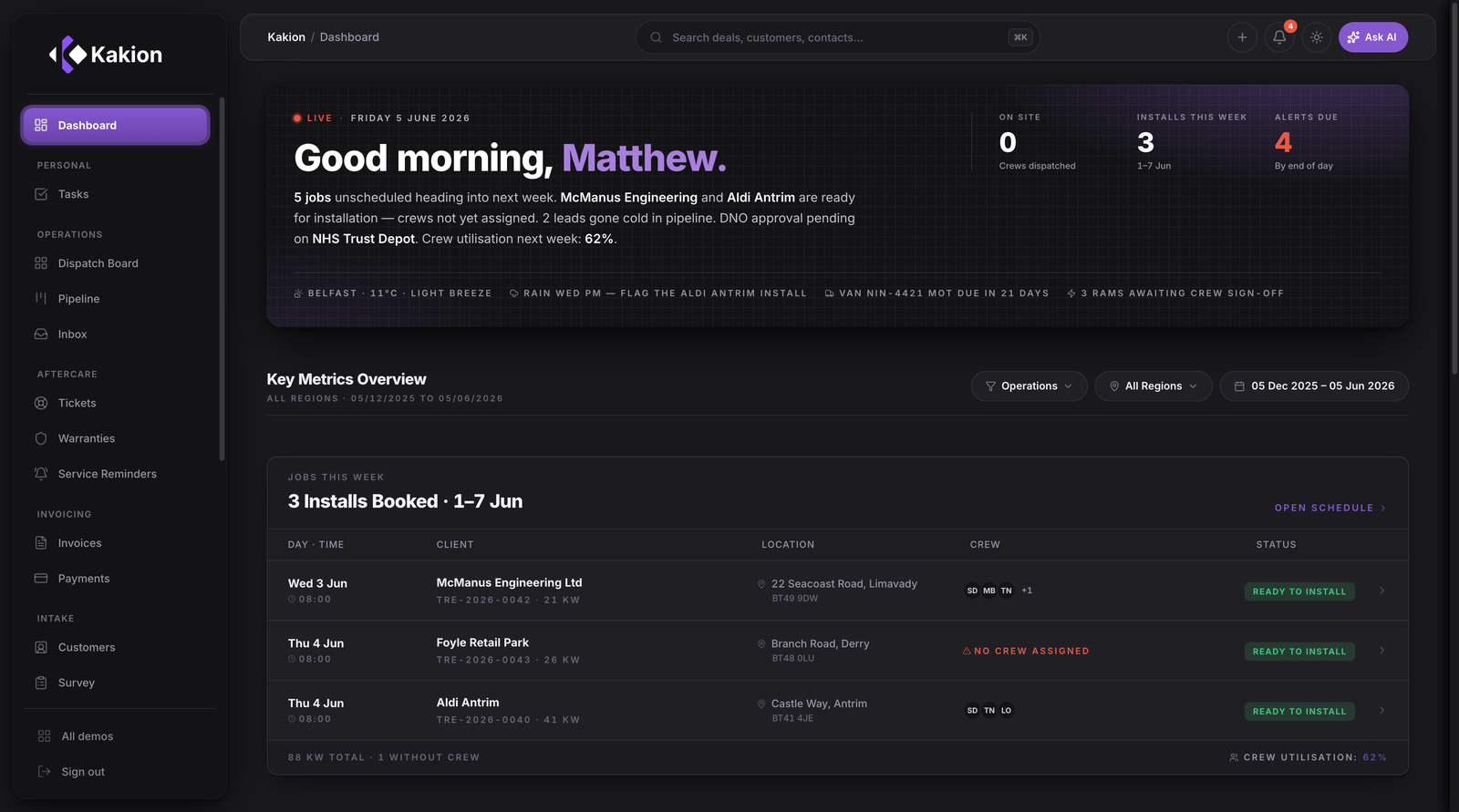
Where Installs Stall and Cash Gets Held Up.
Most solar businesses do the technical work well. The problems are in the gaps between the jobs, where one stage hands off to the next and something falls down the crack. Those gaps are where the money leaks.
Enquiries go quiet because follow-up lives in someone's inbox, not a tracked pipeline.
Quotes do not convert because finance and payback options are not part of the quoting flow. They get added separately, if at all.
RAMS and grid connection paperwork gets done as a scramble after the install, not as a gate before it.
Installers arrive on site without the full job spec, or drive back for a part that was not flagged in the job.
Handover packs and certificates get rebuilt from scratch every time, if they go out at all.
Invoicing waits on the paperwork pile instead of landing when the job closes.
Solar Installer Software That Covers the Whole Job.
Search for solar software and you get pointed at one piece at a time. A CRM for the leads here, a design and quoting tool for the proposals there. Kakion is the one system that runs the whole job.
Most installers end up running two or three of those tools side by side. The leads sit in one place and the quotes get built in another. The install is managed somewhere else again. Nothing talks to each other, so the same job gets keyed in more than once and details fall through the cracks between them.
Solar installer software should follow the job the whole way. Enquiry, survey, quote, install, handover, certificate and the customer you keep for the next system or service. Kakion runs that in one place, built on a proven system and configured for how a solar business actually works.
One Platform for the Whole Installation.
Solar CRM, solar quoting software and solar project management software. Not three separate tools but one operational platform that runs the whole cycle from first enquiry through to certified handover and aftercare. Built on a proven system. Configured for how solar installers actually work.
"We do not fit your business to the software. We fit the software to your business."
- CRM in one app, quoting in a spreadsheet
- Compliance and RAMS tracked separately or not at all
- Installers ringing the office mid-job for missing details
- Handover packs and certificates rebuilt manually every time
- Invoicing from a separate tool, chased by hand
- Enquiry, survey, quote and schedule in one flow
- Compliance gates built into the job, not done until it is done
- Installers equipped on their phones before they leave
- Handover and certificates generated from the job data
- Invoicing closed from the job record, chasing itself
Win the survey, win the job.
From the first enquiry to a signed proposal in one flow. Nothing re-keyed and nothing falling between tools.
- Every enquiry in one solar CRM. Leads from every source land in the one pipeline. Follow-up gets tracked and nothing goes quiet on you. You can see what is coming without having to ask anyone.
- Quoting with finance and payback built in. You build the quote inside the platform, with finance routes and payback figures part of the same flow. It is not a separate spreadsheet you send on after.
- Proposals with electronic sign-off. Branded proposals go out as PDFs with signature capture built in. A yes turns straight into a scheduled job, ready for the install team to pick up.
Get the install done right, first time.
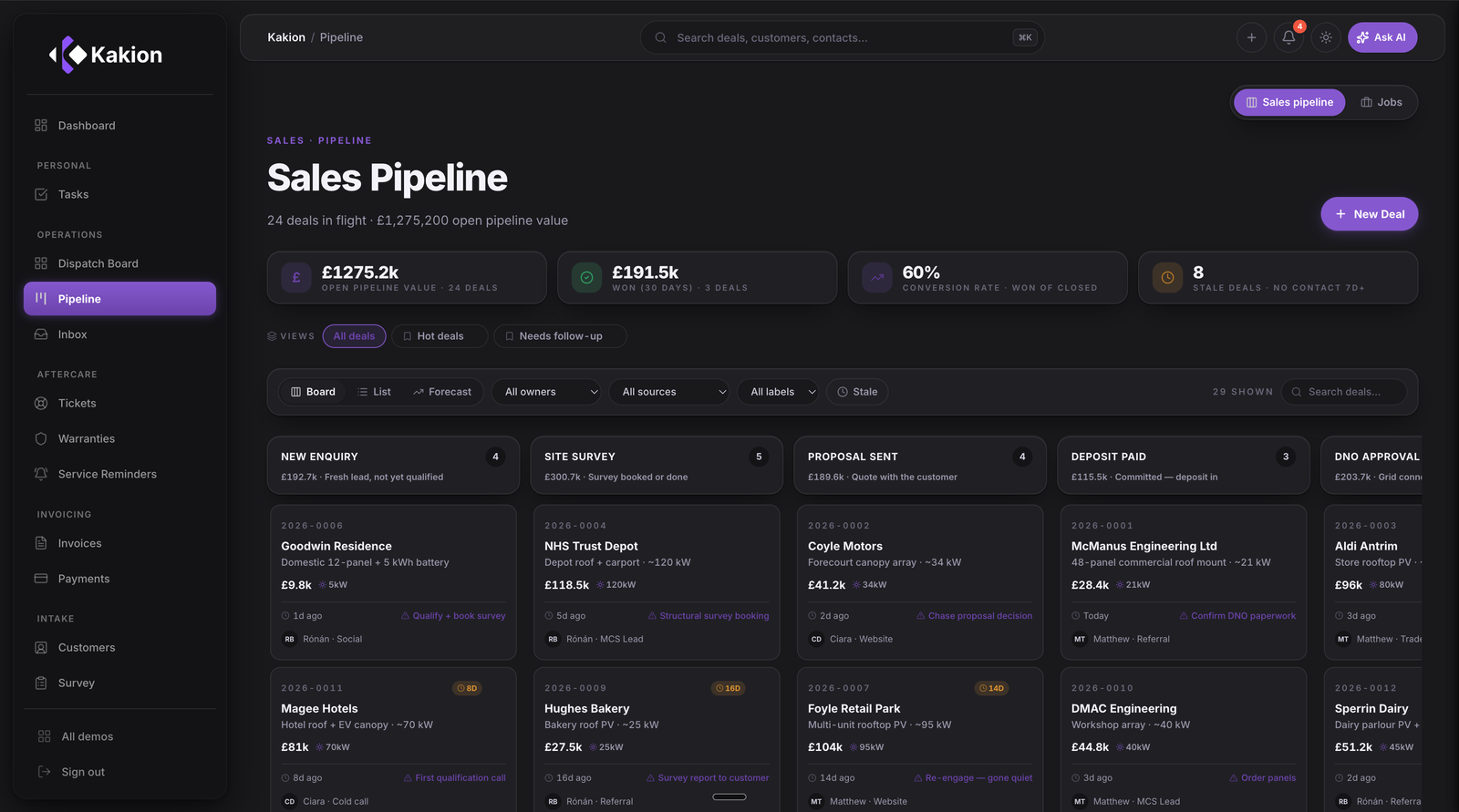
Job management built for solar, with one source of truth for the office and the site, so jobs stop slipping in the handover.
- RAMS signed off before anyone moves. A job cannot go to install until every crew member assigned to it has signed the RAMS. The system holds it, so it does not come down to whoever remembers to check.
- Crews set up on their phones. The full job spec is on the installer's phone before they leave the yard. No ringing the office and no driving back for a part they did not know about. It is field service software that works the way a site day actually runs.
- Photos filed to the job as they are taken. Before, during and after shots attach straight to the job record. Each one timestamped and named with who took it, there when you need it for a warranty or a handover.
- Sign-off locked to the right people. Each role does their own sign-off on site. The job is not done until the right people have confirmed it from the field.
Hand over clean, get paid and keep the customer.
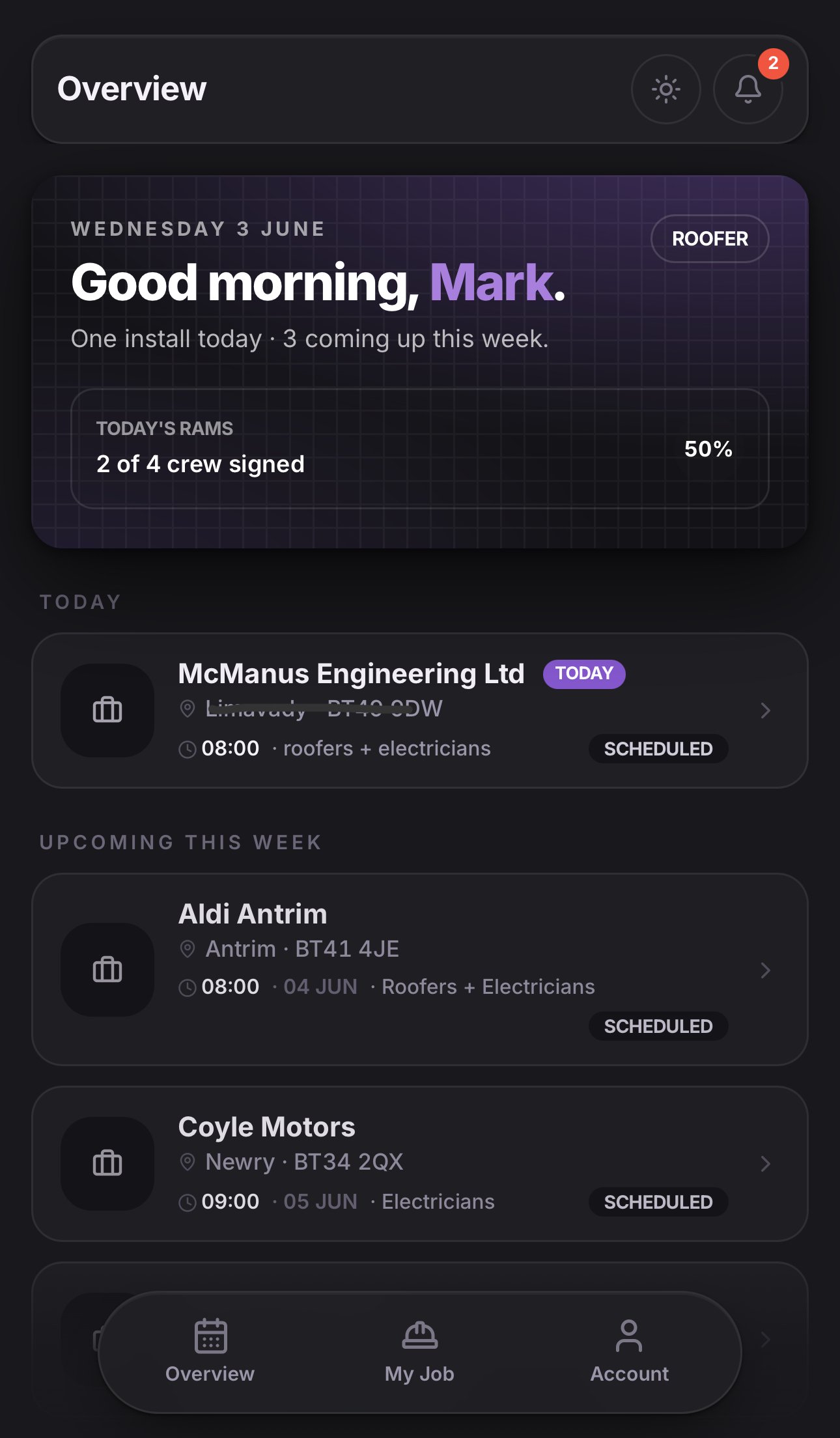
Finish the job the way it should be done. Paperwork sorted, money in and the customer on your books for the next one.
- The whole job is recorded as you do it. What went in, the serial numbers, who signed off, the customer's details, the warranties, the commissioning info. It is all there because it went in on site, not written up after. When the handover and paperwork come round, you are not digging through photos and texts trying to remember what you fitted.
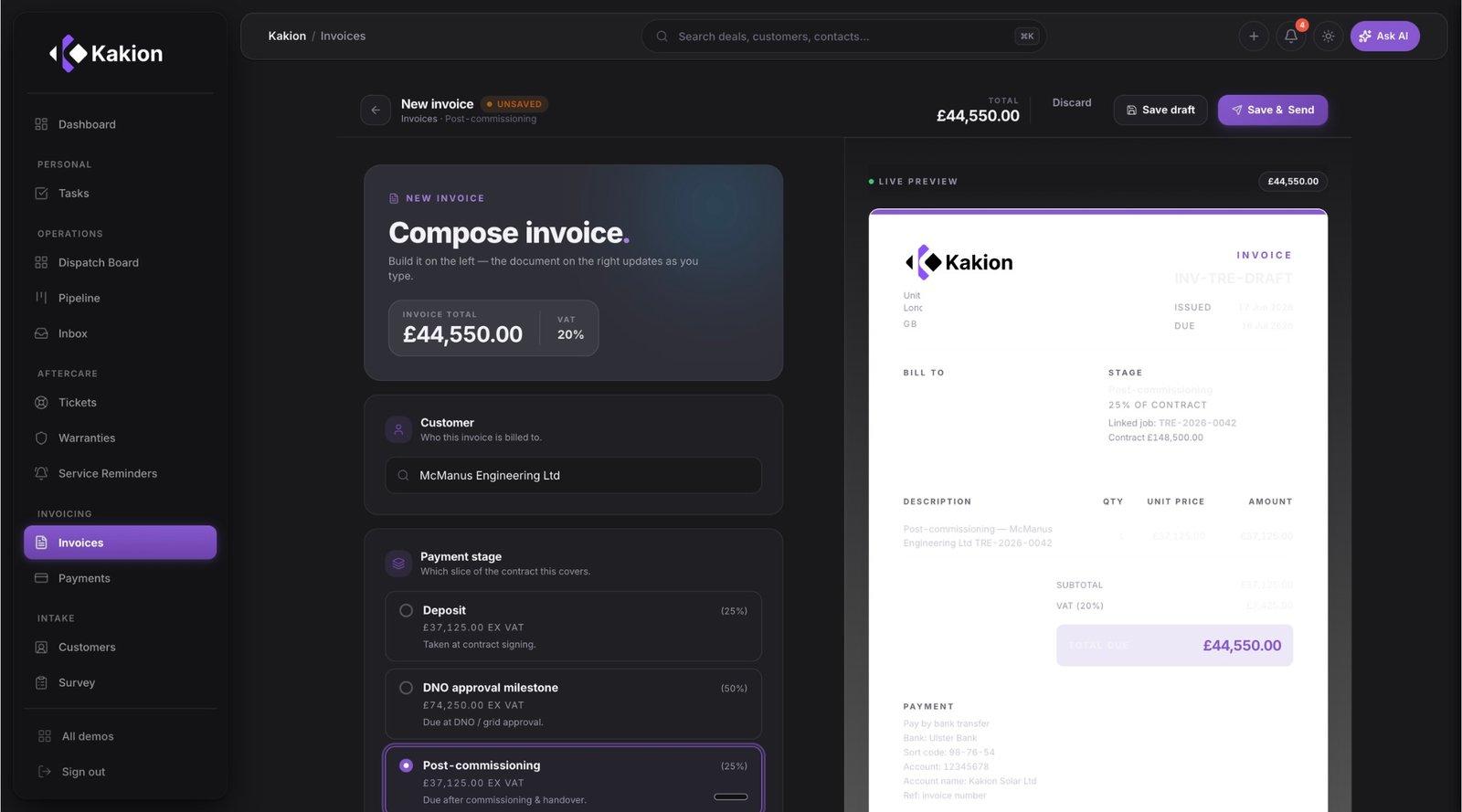
- The invoice is ready the second the job is done. Job management and invoicing run together, so there is no gap between finishing and billing. You get paid quicker and nobody is chasing money weeks later. This part alone pays for the system.
- Every customer stays on file, properly. It is a CRM made for solar installers. Every job a customer has had, what is under warranty, when they were last serviced, what they might need next. Looking after people after the install stops being the thing that slips and starts being where a good chunk of your repeat work comes from.
AI Built Across the Whole System.
The AI layer is not a bolt-on feature. It sits across the whole operational platform, not one role or one workflow but all of them. The result is more capacity without more headcount and a lot less admin.
-
An AI assistant for every role
Each person has an in-app AI assistant scoped to their role, answering from the business's own data. Whether they are on the roof or in the office, they stop hunting for answers across two systems and get on with the work.
-
A daily morning brief, automatically
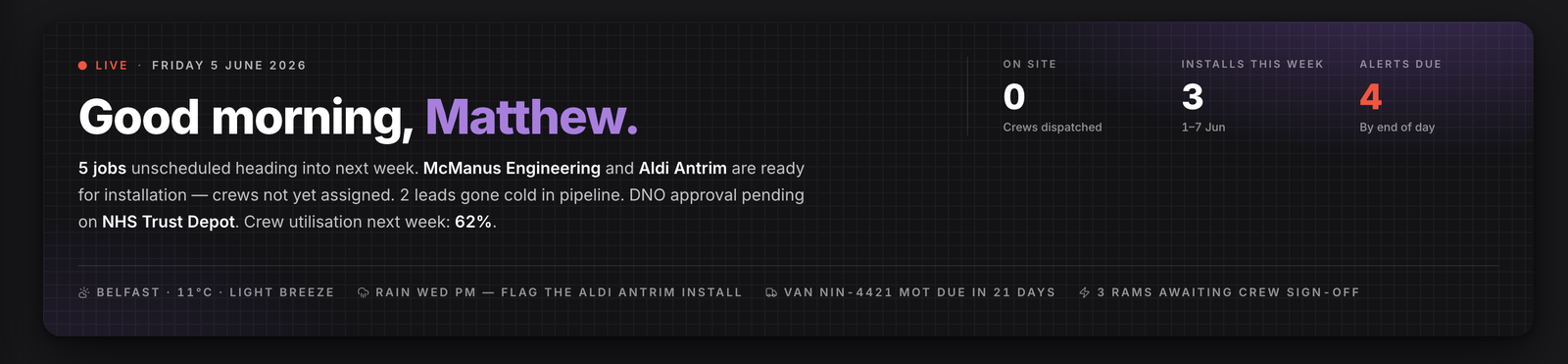
Every morning the platform generates a brief on what matters. Installs scheduled, jobs completed, deals gone stale and invoices overdue. The day starts with clarity instead of piecing it together from several screens.
-
Paperwork that routes itself
Incoming documents get read by the system and routed to the right job or customer automatically. Supplier invoices, compliance correspondence and warranty queries all land where they belong. The "where did that go" question disappears.
Kakion vs the Tools You Are Stitching Together.
If you have been shopping around you have seen the usual names. Joblogic and ServiceM8 on the field service side, OpenSolar for the design and quote, HubSpot or Pipedrive for the CRM. They are all capable at the slice they do.
That is the problem. Each one owns a slice and none of them owns the job. So you pay for two or three subscriptions and you key the same customer into each one. You still do not have a single view of where a job actually is.
Kakion is the other way. One system that runs the CRM, the quote and the install in the same place, so nothing gets re-keyed and nothing falls between tools. You own it. It is built around how you already work, not rented per seat and bent to fit.
We are not the answer for everyone. If one of those tools does everything you need, keep it. If you are living in three of them and stitching the gaps by hand, that is what we replace.
Common Questions.
- What is solar installer software?
- Software that runs a solar or renewables business from the first enquiry to the finished install and beyond. It handles the CRM, the quote with finance and payback, the survey, the RAMS and compliance, the install on site and the handover pack. It keeps the customer on file for servicing and the next system. For an installer it replaces the stack of separate tools most of them run on.
- What does it cost?
- Every build is priced to the job, the same way you price yours. A single retrofit and a full commercial install are not the same number and neither are two solar businesses. We scope it before quoting. We price the whole build up front so there are no surprises. No per-seat licence. No monthly fee that climbs as you take on installers. You own it at the end.
- How long does it take to implement?
- It varies with the build, anywhere from three to twelve months depending on scope. We work in stages and put the first useful part in your hands early, so you are not waiting on the full thing before you see anything. We give you a timeline on the call once we know what the job needs.
- Does it handle the compliance paperwork?
- Yes. RAMS and compliance are built in as gates on the job, so the paperwork is done as you go instead of scrambled together after the install. Handover packs and certificates generate from the job data, from what was actually fitted and signed off on site. The paperwork is ready when the job is, not rebuilt from a template days later.
How We Work
Four steps · start to finish
-
Audit
We map how your business actually runs: workflows, pipeline, content. You see exactly where time, money and leads are leaking and what we’d fix.
-
Build
We build the systems, infrastructure or content engine you need - configured for how your business actually works.
-
Launch
We roll it out, bring your team up to speed and make sure it works the way you work.
-
Support
We stay on call: updates, fixes and improvements as you grow.
Book a Call. We Will Map Where the Installs Leak Time and Money.
We will show you where one system closes the gaps, from the first enquiry to the final certificate.