
Manufacturing software
Manufacturing Software That Runs the Whole Job. Order to Dispatch.
Built for make-to-order manufacturers. Joinery, windows and doors, fabrication, cabinetry. One system from the first enquiry to the invoice going out.

Where the Job Slips and the Cash Sits.
If you make to order, jobs rarely stall because the work is poor. They stall in the gaps between the office and the floor. Every one of those gaps costs money or delays cash coming in.
- Work lives across spreadsheets, email threads and shared folders. There is no single view from order to dispatch.
- Jobs and stock drift out of sync. A build stops because materials were never ordered when they should have been.
- The paperwork is not done so the job cannot be dispatched or invoiced. The cash just sits there.
- The office and the floor are working off different versions of the same job.
- Job costing is a guess. You find out what a job actually cost long after it is done.
A Manufacturing ERP Without the ERP Overhead.
People call this kind of system a manufacturing ERP. Fair enough. It does what an ERP does. Orders, stock, production, job costing and invoicing all in one place, all talking to each other.
What it does not do is drag you through a long rollout or a per-seat licence that climbs every time you hire. A traditional ERP is a big box of features built for factories far bigger than yours. You pay for all of it and you bend your shop to fit the software. Most make-to-order businesses never use half of what they are paying for.
Kakion is built the other way round. We start with how your shop actually runs and build the system to match. You get the ERP outcome, one connected system from order to dispatch, without the cost or the wait.
MRP or ERP? You will see both terms thrown around. MRP is the narrow one. It plans the materials and the production, what you need and when you need it. ERP is the wide one. It wraps the whole business around that, the sales, the stock, the jobs, the invoicing and the rest. Most make-to-order shops do not need to pick a side. You need the material planning to be right and you need it joined to the quote, the job and the invoice. That is what we build.
One Platform. The Whole Operation.
Kakion's manufacturing software replaces a stack of disconnected tools. Your manufacturing CRM, production management software, job management and quoting all in one place that the office and the floor actually share. It is the order-to-dispatch system a traditional manufacturing ERP never quite delivered, without the cost or the long implementation.
- Quoting in a spreadsheet
- Schedule and stock tracked by hand
- Job folders living somewhere else
- Invoicing bolted on at the end
- None of them connected. Details get re-keyed and things slip.
- Order, quote and schedule in one flow
- Stock linked to jobs and deducted automatically
- The floor and the office on the same job
- Handover, certs and invoicing from the same data
- One system from order to dispatch
Win the Order
Enquiries tracked in one place. Quotes that turn straight into scheduled builds with nothing re-keyed.
- Every enquiry in one pipeline. Nothing slips and you can see what is coming without chasing anyone.
- Quoting that becomes the job. When the customer says yes, the spec schedules straight into production. Nobody re-enters it.
Make and Track Every Job
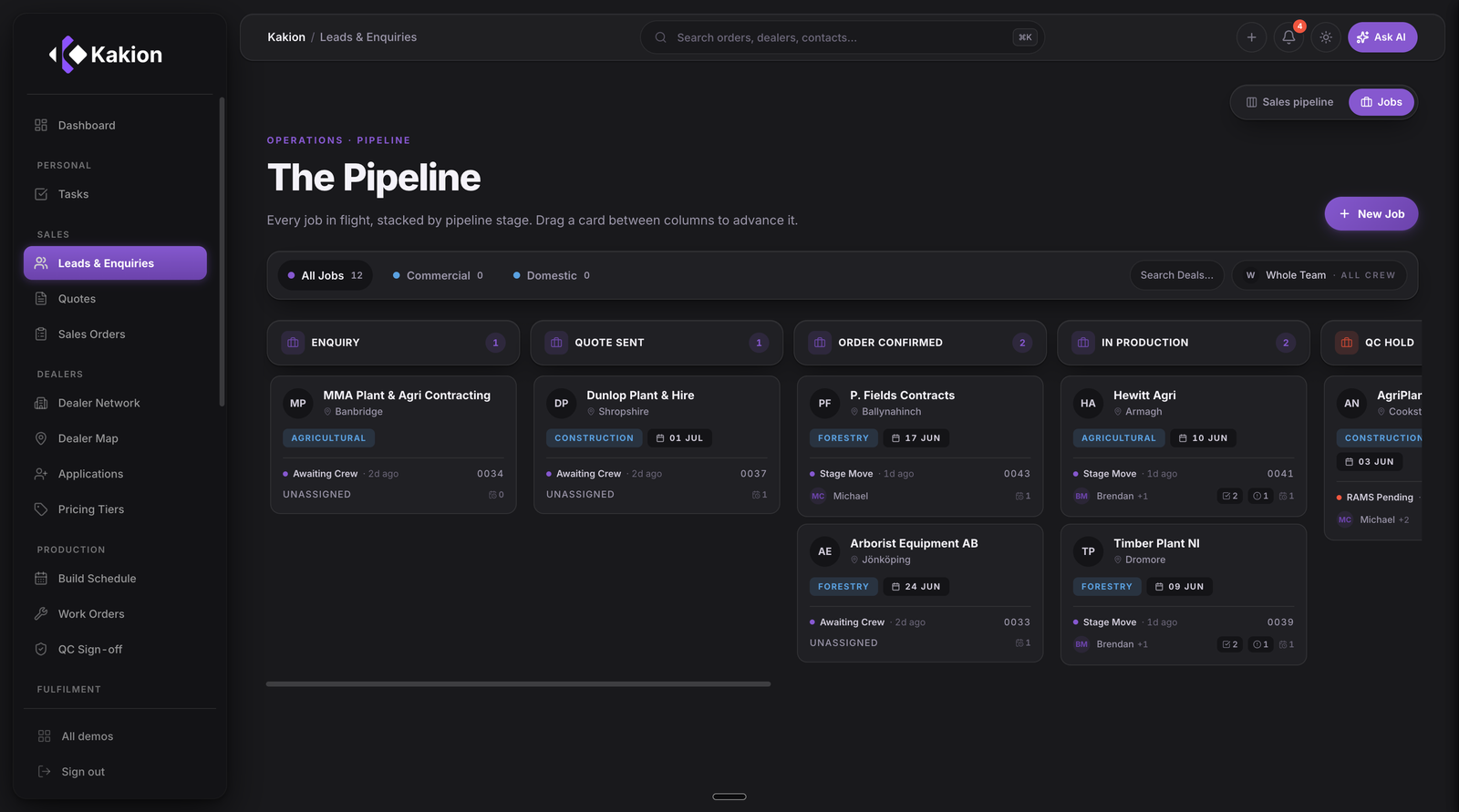
One source of truth for the office and the floor. Jobs stop slipping in the gaps.
- Gate stages a job cannot skip. Each step has to be completed before the next one opens. The errors that cost money on your current setup stop happening.
- Stock management built into every job. Materials are linked to the build and deducted automatically as it progresses. Low-stock alerts raise a purchase order before a shortage holds up production.
- Job costing from live numbers. Stock valuation feeds real costs so you are pricing from what is actually on hand. You find out what a job cost during the job, not weeks after it finishes.
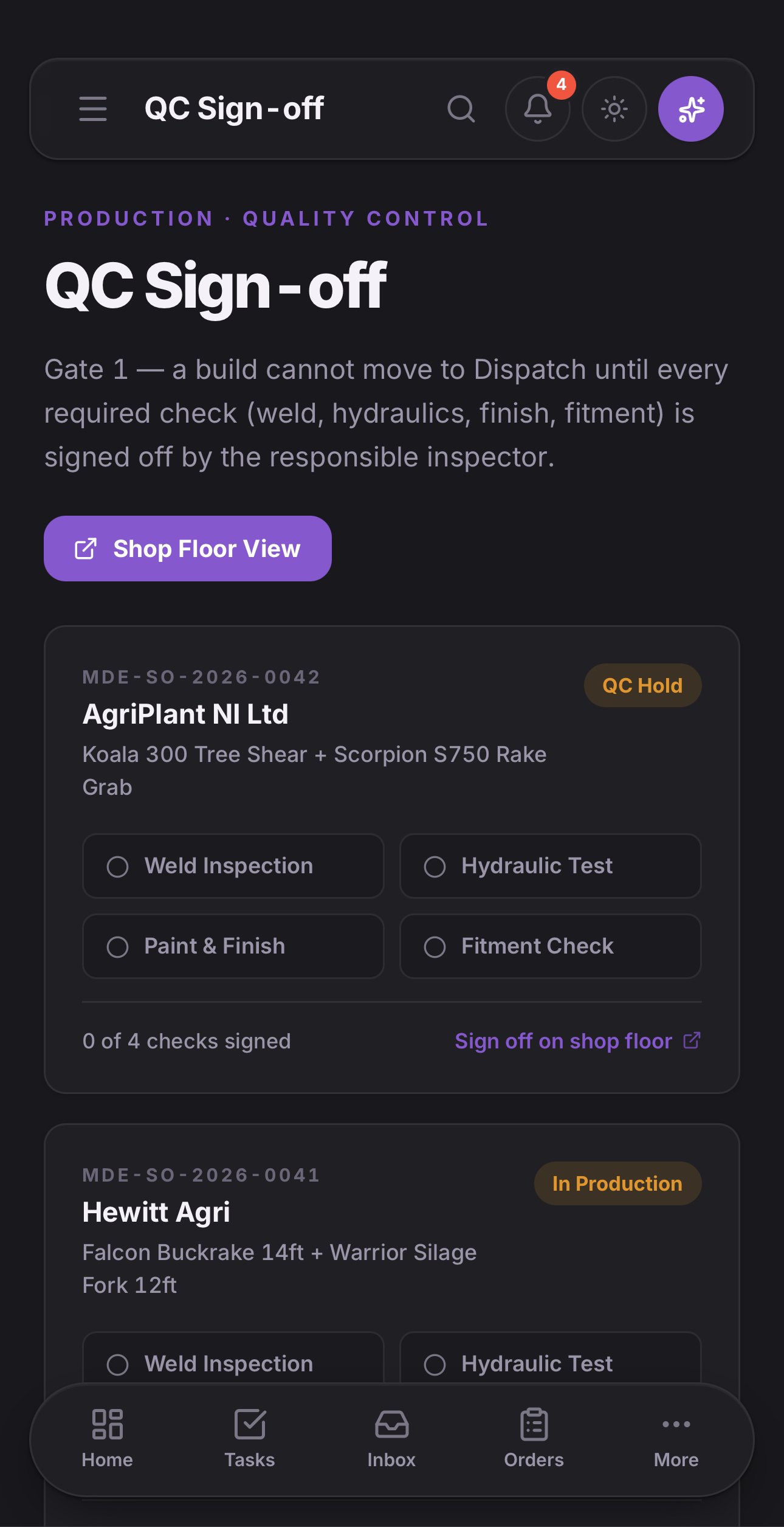
- The floor working from their phones. Role-locked sign-off with photos filed straight to the job. No paperwork to chase before a stage can move.
- RAMS and safety as built-in gates. Compliance is part of the job workflow. The scramble to pull paperwork together at the end of a project stops.
Dispatch, Invoice and Keep Them
Close the job cleanly, get the invoice out and keep the customer for the next one.
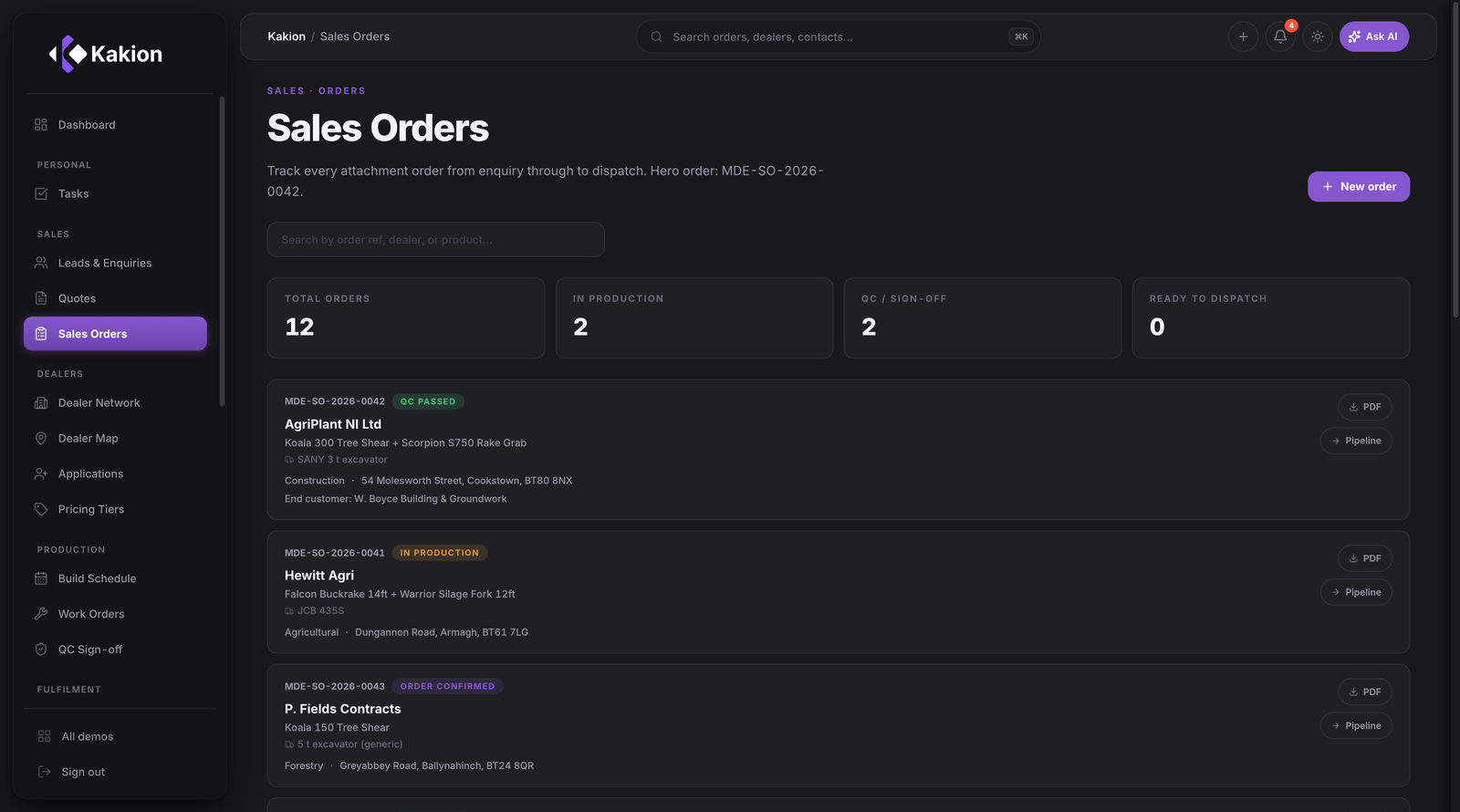
- Handover and cert packs from the job data. Branded and ready to send. Nobody rebuilds a template every time a job goes out.
- Invoicing that chases itself. The system follows up outstanding payments so your team does not have to. Cash comes in sooner.
- Customer accounts and aftercare in one place. Full order history to hand so repeat work and service calls are easy. Nothing about the customer relationship gets lost.
Production Scheduling You Can Actually See.
Most shops schedule in someone's head or on a whiteboard by the door. It works until it does not. Someone is off sick, a delivery is late and nobody knows what should be on the bench today.
Kakion gives you production scheduling that lives in the same system as the jobs. When a quote is accepted it drops onto the schedule with the work it needs and the materials it needs. You can see what is on the floor now and what is coming next week. You can see where a job is going to run tight before it does.
Move a job and the rest moves with it. The materials and the dispatch date update on their own and the plan stays right without anyone redoing it by hand. The office and the floor look at the same schedule, so nobody is building last week's plan.
AI Built Into the Workflow.
Our manufacturing software has AI built into the workflow rather than added on top. The result is more capacity without more headcount and a lot less admin.
-
An AI assistant for every role
Each person has an in-app assistant scoped to their role, answering from your business's own data. They stop hunting for information and get back to the actual work.
-
A daily morning brief, automatically
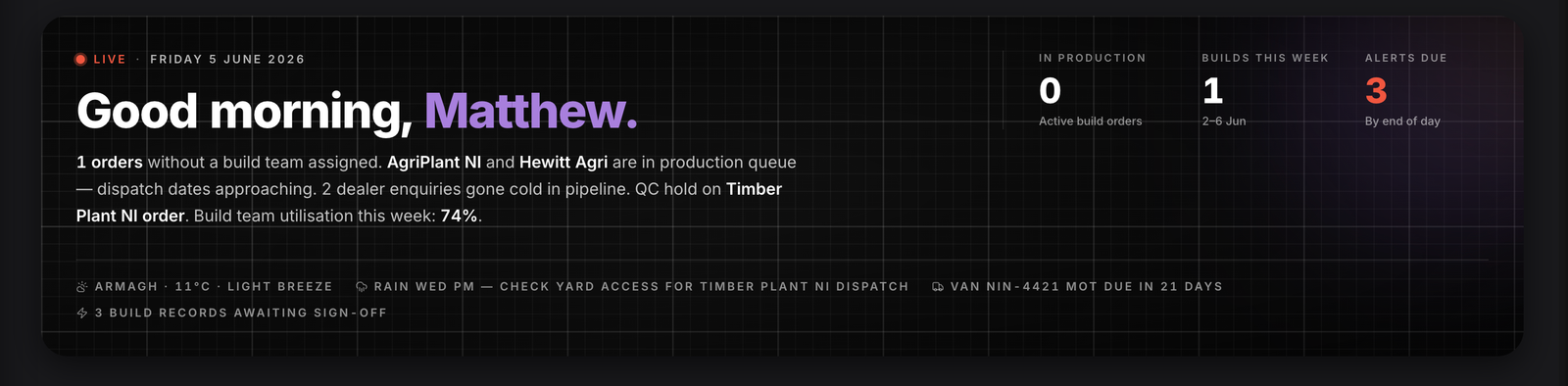
Every morning the system sends a rundown on what matters that day. Jobs, orders, stock and overdue invoices. The team starts knowing what is on without a meeting.
-
Paperwork that routes itself
Document intelligence reads incoming paperwork and files it against the right job or supplier automatically. Supplier invoices, customer queries. Each one lands where it belongs.
Kakion vs the Off-the-Shelf Tools.
If you have been looking at manufacturing software you have probably seen Katana, MRPeasy, Fulcrum and Statii. They are solid tools. They are also all the same shape. You rent them by the seat and you fit your shop around how they work.
That is fine if your shop runs like the shop they were built for. Most make-to-order businesses do not. You end up paying every month for features you never touch and working around the bits that do not fit.
Kakion is the other option. One system built for your process, not rented and bent to someone else's. You own it. It does what your shop does and nothing it does not. No per-seat licence climbing every time you take someone on.
We are not for everyone. If a standard tool fits how you work, buy the standard tool. If it does not, that is where we come in.
Common Questions.
- What is manufacturing ERP software?
- One system that runs the whole manufacturing business instead of a stack of separate tools. Orders, stock, production, job costing and invoicing live in the same place and talk to each other. Traditional ERPs do this for big factories at a big price. Kakion does it for make-to-order shops, built around how you already work.
- What does it cost?
- Every build is priced to the job, the same way you price yours. A one-off staircase and a batch of standard units are not the same number and neither are two manufacturing systems. We scope it before quoting. We price the whole build up front so there are no surprises. No per-seat licence. No monthly fee that climbs as you hire. You own it at the end.
- How long does it take to implement?
- It varies with the build, anywhere from three to twelve months depending on scope. We work in stages and put the first useful part in your hands early, so you are not waiting on the full thing before you see anything. We give you a timeline on the call once we know what the job needs.
- Does it work for make-to-order manufacturing?
- That is exactly what it is built for. Every job is different, every quote is its own spec and nothing comes off a fixed catalogue. The system schedules from the quote, links the materials to the build and tracks the job to dispatch. Joinery, windows and doors, fabrication, cabinetry, that is the shop we build for.
How We Work
Four steps · start to finish
-
Audit
We map how your business actually runs: workflows, pipeline, content. You see exactly where time, money and leads are leaking and what we’d fix.
-
Build
We build the systems, infrastructure or content engine you need - configured for how your business actually works.
-
Launch
We roll it out, bring your team up to speed and make sure it works the way you work.
-
Support
We stay on call: updates, fixes and improvements as you grow.
Book a Call. We Will Map Where It Leaks.
Show us the operation and we will show you where one system changes it.